Platform guide
All Zelda Game Boy games
Four Zelda cartridges came out for the Game Boy and Game Boy Color: Link’s Awakening, its colour remake, and the two Oracle games Capcom built to be played as a pair. Whether you search for “game boy” or “gameboy”, these are the four — and on this platform, unlike any later one, the save battery decides what a used cartridge is worth.
The short answer
Link’s Awakening (1993, Game Boy) → Link’s Awakening DX (1999, Game Boy Color) → Oracle of Ages and Oracle of Seasons (both 2001, Game Boy Color). Start with the DX version if your console is a Game Boy Color or newer. The two Oracle games link to each other with a password.
Every Zelda Game Boy cartridge, in release order
| Game | Year (EU) | Console |
|---|---|---|
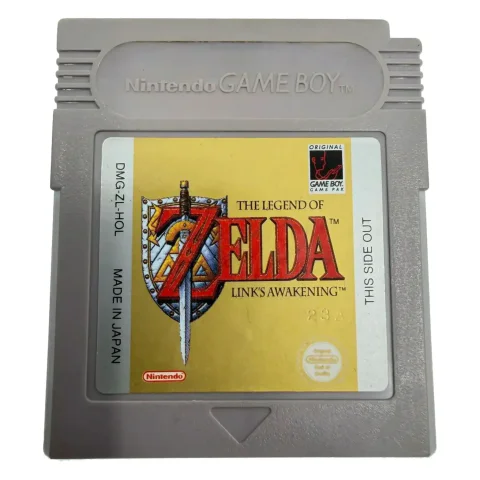
| Link's Awakening | 1993 | Game Boy |
| Link's Awakening DX | 1999 | Game Boy Color |
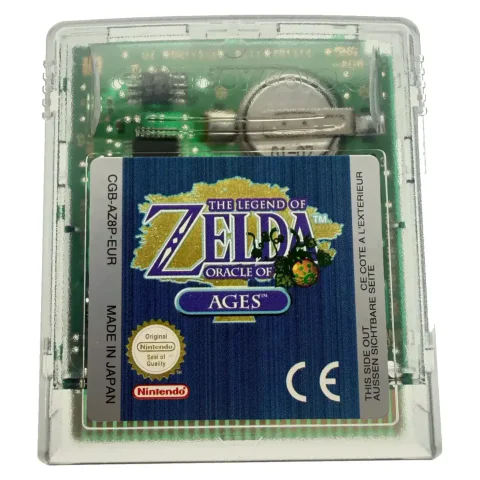
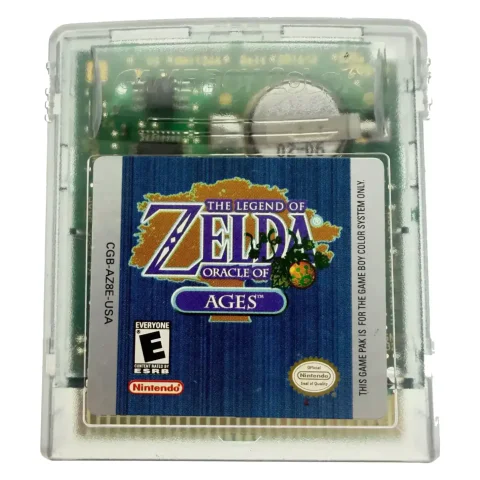
| Oracle of Ages | 2001 | Game Boy Color |
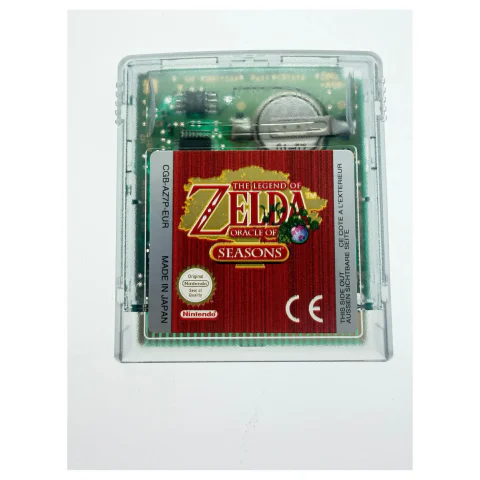
| Oracle of Seasons | 2001 | Game Boy Color |
Game by game — the buying notes
The Legend of Zelda: Link's Awakening (1993)
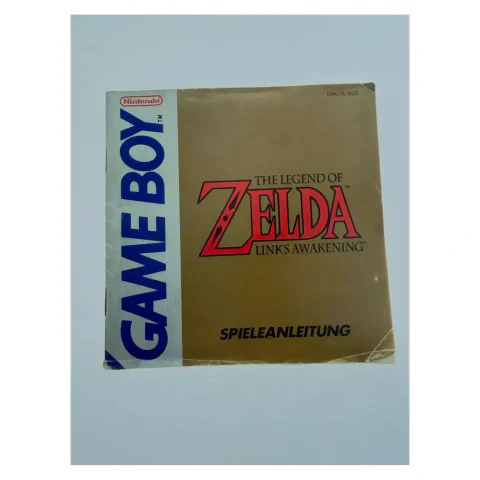
The first handheld Zelda, and the one that proved the series did not need Hyrule — no Ganon, no Triforce, an island that turns out to be something else entirely. Started as an after-hours experiment by the development team. The original grey cartridge is the cheaper of the two versions and plays on every Game Boy ever made.
The Legend of Zelda: Link's Awakening DX (1999)
The same game in colour, with an extra colour-based dungeon, a photographer who follows you around, and support for the Game Boy Printer. Europe got it in January 1999, a month after America. It plays on a Game Boy Color, a Game Boy Advance and a DS or DS Lite — but not on the original grey Game Boy, which is the one thing the plain 1993 cartridge does better.
The Legend of Zelda: Oracle of Ages (2001)
The puzzle half of the pair, built around travelling between two time periods. Made by Capcom, not Nintendo — the same team that later made The Minish Cap. Slightly the harder of the two, and usually the pricier.
The Legend of Zelda: Oracle of Seasons (2001)
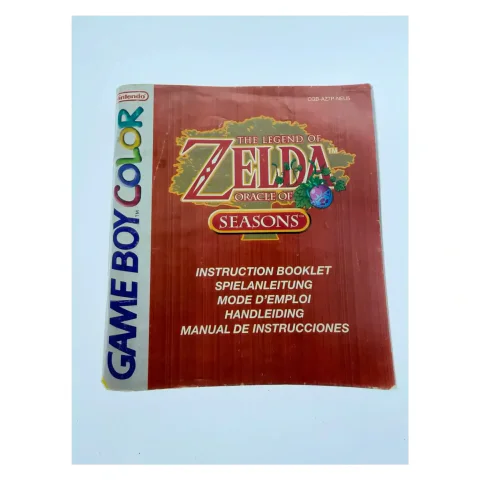
The action half, built around changing the season to reshape the map. Released the same day as Ages and designed to be played with it: finish one and you get a password that unlocks a longer, linked version of the other, with a different ending. Two cartridges and a link cable also let you trade rings.
The save battery — the one thing to check
A Game Boy or Game Boy Color cartridge stores its save in memory that a small coin cell keeps powered. Those cells were soldered in twenty-five to thirty years ago. When one runs flat the game still boots and still plays perfectly — it simply forgets everything the moment you switch off. On a Zelda, which is thirty hours long, that is the difference between a game and a demo.
It is repairable: the cell is a standard CR2025 and replacing it takes a soldering iron and ten minutes, though the existing save is lost in the process. So a flat battery is a price point, not a dead cartridge — as long as the listing tells you. We start a save on every Game Boy cartridge we sell, switch the console off, and switch it back on to see whether the save is still there. Later handhelds do not have this problem at all: Game Boy Advance cartridges use flash or EEPROM and DS cards use flash, neither of which needs power to remember.
Or buy one that has already been checked
Every Game Boy cartridge we sell is play-tested on real hardware with the save switched off and back on, and the battery state is stated on the listing. We have been doing this since 2019, with 1400+ verified reviews at 5.0★, and we ship tracked to all 27 EU countries.
Browse tested Game Boy gamesQuestions we get asked
How many Zelda games are there on the Game Boy?
Four cartridges: Link’s Awakening (1993) on the original Game Boy, Link’s Awakening DX (1999) on Game Boy Color, and Oracle of Ages and Oracle of Seasons (both 2001) on Game Boy Color. The DX version is the same game as the 1993 one in colour, so in terms of separate stories there are three.
Which order should I play the Oracle games in?
Either. They came out the same day and each works on its own. Finish one and it gives you a password for the other, which unlocks a linked version with extra items, extra scenes and a longer ending in which Twinrova revives Ganon. Ages is the puzzle-heavy one, Seasons the action-heavy one — start with whichever appeals, then carry the password across.
Do these games still save? What about the battery?
This is the one thing to check on a Game Boy Zelda, and it is different from later handhelds. Game Boy and Game Boy Color cartridges keep the save in memory powered by a coin cell soldered to the board. Those cells are now twenty-five to thirty years old, and when one dies the game still plays but will no longer save. It is replaceable — a CR2025 and a soldering iron — so treat a flat one as a price point rather than a dead cartridge. Game Boy Advance and DS games do not have this problem: they write to flash or EEPROM, which needs no power.
Which consoles play them?
The original 1993 Link’s Awakening plays on everything from the 1989 Game Boy to a DS Lite. The three Game Boy Color cartridges need at least a Game Boy Color; they also run on a Game Boy Advance, a Game Boy Advance SP, a Game Boy Micro and the original DS or DS Lite. None of them runs on a DSi, 3DS, 2DS or Switch — those have no Game Boy slot at all.
Are Game Boy cartridges region-locked?
No. A European cartridge plays on an American or Japanese Game Boy and the other way round. What differs is the language on the label and in the game. Everything we sell is the European version unless the product page says otherwise.
Do you ship Zelda Game Boy games across the EU?
Yes — tracked shipping from the Netherlands to all 27 EU countries, no customs charges inside the EU, and 30 days to return an order. Your country’s exact rate appears at checkout before you pay.
One console up: all Zelda GBA games, then the DS pair and the 3DS ones — or the whole series in order. Same cartridge slot, different franchise: all Pokémon Game Boy games.
Dutch reader? Zelda Game Boy-games — dezelfde lijst in het Nederlands.