Ordering from Cyprus
Frequently asked questions — ordering from Cyprus
Everything buyers in Cyprus ask before they order, answered in one place: how the parcel travels and how long it takes, why there is no customs to pay, how you pay and how a return works — and the general questions about our games, consoles and Pokémon cards.
Frequently asked from Cyprus
Where can I buy second-hand Nintendo games and Pokémon cards in Cyprus?
Right here, online: Gameshop Enter is a second-hand video game shop for Nintendo games, consoles and Pokémon TCG cards — Game Boy, GBA, DS, 3DS, Switch, N64 and GameCube — every game and console personally tested, every card checked by hand. We ship to any address in the Republic of Cyprus: every order leaves our stock in Enter, the Netherlands, on the next working day and travels to Cyprus with PostNL — always tracked to your door. Delivery time 5-9 business days; Cyprus is the farthest EU destination from the Netherlands, so count on the upper end. At checkout you enter your four-digit postcode (for example 1010 for Nicosia).
What does shipping to Cyprus cost?
At most €15.90 for games or a handheld console (up to 2 kg, priced by weight) and €31.00 for a home console or anything heavier. Cyprus is one of the farther PostNL zones in the EU, which is why it costs more than a parcel to Germany or France; a second game adds only a little. You see the exact amount in your cart as soon as you choose Cyprus — and that is exactly what you pay.
Will I pay customs or VAT?
No. Cyprus has been in the EU since 2004 and uses the euro, and the Netherlands is in the same customs union: no customs declaration, no import duty and no import VAT for an address in the Republic of Cyprus. We sell under the margin scheme, so no VAT is added to the price either. The amount at checkout is the final amount, and nobody collects anything at the door.
How can I pay from Cyprus?
Through Mollie, a payment provider regulated by the Dutch Central Bank: credit card, PayPal, Pay by Bank or bank transfer, and on your phone Apple Pay and Google Pay. You pay in euros — no conversion, no exchange fees.
Are the games authentic?
Every cartridge is personally tested and checked for authenticity before it goes online — label finish, product code, weight and a working save function, plus the security screw and the board inside on Game Boy cartridges. If you ever receive a fake from us: money back.
Do PAL games from the Netherlands work on my console?
Yes. Our games are European PAL editions — the same region as consoles sold in Cyprus and the rest of Europe. Game Boy, GBC, GBA, DS, Switch, PS4 and PS5 have no region lock at all; 3DS, Wii, Wii U, GameCube, N64, SNES and NES do, but a European console plays a European edition without any trick. Product pages state the region for every item.
Do the consoles work with Cypriot plugs?
Yes. Consoles come with a European power supply for 230 V, and Cyprus’s 240 V mains is fine for it. Only the plug differs: Cyprus uses the British three-pin socket, so the European two-pin plug needs a simple adapter — no voltage converter. The Game Boy family runs on batteries anyway.
What about returns from Cyprus?
You have 30 days — more than the 14 days the law requires. Send us a message and we will sort it out together; the return goes to our address in the Netherlands, inside the EU, so no customs form. The return postage is at your own cost, unless the item is faulty or we made a mistake — then we pay it and you get the full amount back.
Who is behind Gameshop Enter?
A registered Dutch business — KvK no. 93642474 (Dutch trade register) — based in Enter, in the province of Overijssel. Lenn has run the shop alone since 2019: from testing the cartridges to packing your order. He answers questions personally, by e-mail or through the chat on every page.
Can I follow the parcel?
Yes — the parcel leaves the Netherlands with a PostNL tracking number that follows it door to door in Cyprus. The shipping e-mail carries it; you can also follow it from the order page on this site, and ask us in the chat at any point.
How are the games packed for the journey?
Cartridges and cards travel in a rigid, padded parcel; boxed games and consoles are wrapped and boxed with padding on every side. Every parcel is tracked, and a loose cartridge never travels in a plain envelope.
Games, consoles and cards — the general questions
Are all products original and tested?
Yes, everything we sell is 100% original. Every product is personally tested before it goes into our shop: we check function, authenticity and the condition of label and casing. Games that don’t meet our quality standard are not offered, and we don’t sell reproductions or counterfeits. Every product page clearly states the condition and completeness.
How do I know a Pokémon cartridge is genuine?
All Pokémon cartridges we sell are 100% authentic. We check every copy for the official Nintendo features: the correct label, the right cartridge colour, the serial number on the back and the Nintendo logo in the casing. Every cartridge is personally tested and checked for authenticity.
What do the condition grades mean?
We use three conditions. “Good condition”: neat, fully function-tested, minimal signs of use. “Acceptable condition”: visible signs of use, but fully working. “Poor condition”: clearly damaged or scratched, but tested and fully working. Not every title is in stock in every condition: the product card and the product page show whether a title is for sale in 1, 2 or 3 conditions, each with its own price. For every condition we also state the completeness.
How do I know whether a product is complete?
We clearly state the completeness of every product. “Boxed” means the game comes with its original box; a manual may be included but is not guaranteed — we always say whether it is. “Cartridge only” means you get just the game itself, without original packaging. Boxed games are rarer and worth more to collectors.
Are the photos on the product page of the actual product?
We use stock photos that show the product accurately. The copy you receive may differ slightly in appearance, for example small signs of use or a slightly different label colour. The condition and completeness stated on the product page are always correct.
Why is a boxed copy more expensive?
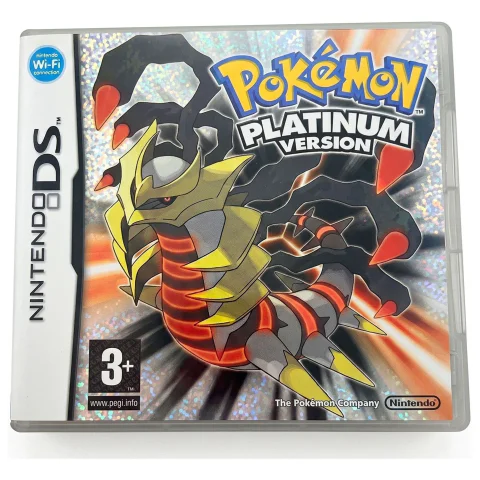
A boxed copy includes the cartridge with its original box. Because boxes were often thrown away, these copies are much rarer than loose cartridges. Especially with older Pokémon games such as HeartGold, SoulSilver and Platinum, the price difference can be considerable.
What is the difference between an EUR and a USA version?
EUR (PAL) versions are the European releases, often with multilingual manuals and a slightly different label design. USA (NTSC) versions come from North America. For DS games it makes little difference in practice: they are region-free and work on European systems, just like Game Boy and GBA cartridges. A USA version of a 3DS game, on the other hand, won’t start on a European 3DS or 2DS — the 3DS is region-locked. We clearly state the version for every product.
Which platforms do you sell games for?
We sell original games for NES, Super Nintendo, Game Boy / Color, Game Boy Advance (GBA), Nintendo DS, Nintendo 3DS, Nintendo 64, GameCube, Wii, Wii U and Nintendo Switch, plus PlayStation 4 and 5. From Pokémon and Zelda to Mario — our range keeps growing.
Do you also sell consoles?
Yes! We also sell second-hand Nintendo consoles, such as Game Boy, GBA SP, DS Lite, 3DS and Switch. In the shop, filter on “Consoles” to see what is in stock. Every console is personally tested and works 100%.
Can a cartridge’s internal battery be dead?
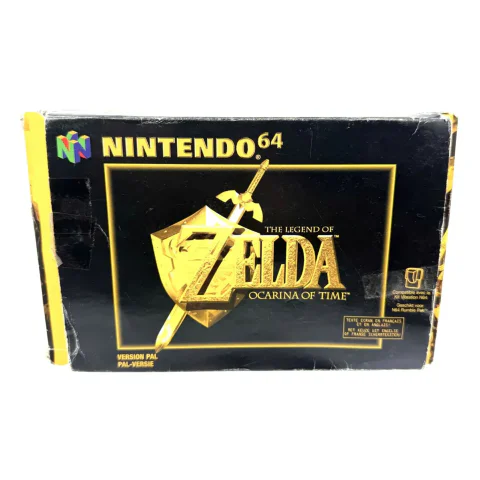
That depends on the generation. In Game Boy and Game Boy Color games (Pokémon Red up to Crystal) and in Ocarina of Time on N64, the battery holds the save itself: if it is dead, the game still plays but no longer remembers anything. We test this and state it per copy. GBA games such as Emerald, Ruby and Sapphire have an internal battery only for the clock: if it is dead, time-based events (growing berries, tides) stop working, but the game and your saves still work. DS and 3DS games have no internal battery.
Which language are the games in?
That differs per game; where we know it for sure, the product page shows the game language in the specifications. Our copies come from the Dutch market: on Game Boy, Game Boy Advance and Nintendo 64, English is the norm. Pokémon games have never had a Dutch option, so our copies play in English; on 3DS and Switch you can also choose French, German, Spanish or Italian at start-up. Many Nintendo titles on Wii, 3DS, Wii U and Switch, such as Mario Kart and Animal Crossing, offer several European languages. An edition in another language (French, Japanese, American) is always named in the product name. Unsure about a specific game? Ask us — we check it on the box.
Do Nintendo DS games also work on a 3DS or 2DS?
Yes. A DS cartridge plays on the whole family: DS, DS Lite, DSi, DSi XL, 3DS, 3DS XL, 2DS, New 3DS (XL) and New 2DS XL. Almost all DS games are also region-free; only DSi-enhanced titles such as Pokémon Black and White are region-locked on a DSi or 3DS. It doesn’t work the other way round: a 3DS game only plays on a 3DS or 2DS model and is region-locked (European game on a European console). Game Boy Advance games only fit in the second slot of the original DS and the DS Lite — the DSi, 2DS and 3DS no longer have that slot. Every product page has a compatibility table for that exact game.
Does a second-hand console come with a charger?
Every console with a rechargeable battery comes with its original charger: Game Boy Advance SP, Nintendo DS and DS Lite, DSi and DSi XL, all 3DS and 2DS models and the Nintendo Switch. A home console comes with its original power adapter. Exactly which charger is stated on the product page. The classic Game Boy, Game Boy Pocket, Game Boy Color and the first Game Boy Advance have no charger: they run on AA batteries.
Are there still saved games on the cartridges?
Most second-hand cartridges still contain saves from the previous owner. You can easily delete them yourself from the game’s start menu. This does not affect how the game works.
Are sealed Nintendo games a good investment?
Sealed (unopened) Nintendo games have been rising in value for years, especially popular titles such as Pokémon HeartGold, Emerald and Zelda. Supply keeps shrinking because copies get opened.
How do I spot a fake Game Boy Advance cartridge?
Check: 1) the label — original GBA games have a sharp print with a metallic sticker; 2) the cartridge colour — some games (e.g. Pokémon) have unique colours; 3) the screw — Nintendo uses tri-wing screws, not Phillips; 4) the circuit board — an original board has “Nintendo” engraved on it.
Which Pokémon games are worth the most?
The most expensive Pokémon games are sealed copies of HeartGold, SoulSilver, Emerald, FireRed and LeafGreen. Loose cartridges of Gen 3-5 (GBA/DS) are also sought after and rising in value. See our Pokémon range for current prices.
Do you also have rare or sealed games?
Yes. Rare games, sealed copies and complete collector’s items are simply in the shop.
Glossary — Nintendo & retro gaming terms
Terms you often come across when buying Nintendo games.
- Sealed
- An unopened Nintendo game in its original factory shrink wrap. Rarer than complete-in-box and two to five times as expensive — especially popular with collectors.
- Complete-in-box (CIB)
- A Nintendo game with its original box and manual. Thirty to a hundred per cent more expensive than a loose cartridge, because boxes were usually thrown away back then and have become rare.
- Boxed
- A cartridge with its original box, where the manual doesn’t have to be included. Not quite the same as complete-in-box.
- Cartridge only
- Just the playable game card, without original packaging or manual. The cheapest and most common option for players.
- Reproduction (repro)
- A counterfeit cartridge that looks like an original Nintendo game. Often recognisable by a glossy instead of matte label, a Phillips screw instead of the original security screw, a lighter colour and a missing Nintendo triangle pattern on the back.
- Tri-wing screw
- The three-pointed (Y-shaped) screw that closes a Game Boy Advance cartridge at the factory; Game Boy, GBC, NES, SNES and N64 cartridges have a 3.8 mm gamebit screw. A Phillips screw almost always points to a reproduction or a cartridge that has been opened before.
- Save battery (CR2025/CR1616)
- The internal lithium battery in older cartridges. On Game Boy and Game Boy Color (Pokémon Red, Blue, Gold, Silver, Crystal) and in Ocarina of Time on N64 it keeps the saved games alive; in Ruby, Sapphire and Emerald on GBA only the clock — the save is stored in flash there. It lasts about ten to fifteen years and can be replaced: a CR2025 for Game Boy and Game Boy Color, a CR1616 for Game Boy Advance.
- PAL
- The European TV standard (Phase Alternating Line). PAL Nintendo games work on European consoles; NTSC (American/Japanese) usually doesn’t without a region mod. All our games are PAL.
- NTSC (NTSC-U / NTSC-J)
- The North American (NTSC-U) and Japanese (NTSC-J) TV standard. NTSC Nintendo games don’t simply work on European (PAL) consoles without a region-lock mod.
- Backwards compatible
- A console that can also play its predecessor’s games. The Nintendo 3DS plays DS games and the DS Lite plays GBA games, but the Switch is NOT backwards compatible with DS/GBA/3DS/Wii U cartridges.
- Handheld
- A portable Nintendo console: Game Boy, Game Boy Color, Game Boy Advance, Nintendo DS, Nintendo 3DS or Switch Lite. As opposed to home consoles (N64, GameCube, Wii, Wii U, Switch in its dock).
- Margin scheme (art. 28b Dutch VAT Act 1968)
- The Dutch VAT scheme for second-hand goods. The seller charges VAT only on the margin between purchase and sale price, not on the full sale price. As a result, invoices show no separate VAT. We fall under this scheme.
- Region lock
- A factory lock that refuses cartridges from other regions. Game Boy (Color), GBA, DS and Switch are region-free (they work worldwide), but Nintendo 3DS, N64, GameCube, Wii and Wii U are region-locked: an American (NTSC-U) or Japanese (NTSC-J) 3DS game won’t work on a European console.
- JP cartridge
- A Nintendo game released in Japan (NTSC-J). Often rarer and cheaper than European versions, but the menu languages are usually Japanese. On Game Boy, GBA, DS and Switch they work without a region lock; on 3DS, N64, GameCube and Wii only with a Japanese console.
- Dual-slot mode
- A DS feature that lets you insert a GBA cartridge in slot 2 (at the bottom) while a DS cartridge runs in slot 1. Pokémon Diamond, Pearl and Platinum use it to transfer Pokémon from Ruby, Sapphire, Emerald, FireRed and LeafGreen.
- Pokéwalker
- The round step counter that came with Pokémon HeartGold and SoulSilver in 2010. You put one Pokémon in it and take it along; on the way it earns experience points and finds items. Runs on a CR2032 coin cell. An original Pokéwalker makes a complete copy of HeartGold or SoulSilver worth considerably more — on its own it sells for €40 to €80.
- Mega Evolution
- A temporary, stronger form introduced in 2013 in Pokémon X and Y, which returned in Omega Ruby, Alpha Sapphire, Sun and Moon. X and Y had 28 Mega forms, Omega Ruby and Alpha Sapphire raised that to 48, and you can Mega Evolve only one per battle. Not in Sword and Shield or Scarlet and Violet, but it returned in 2025 in Pokémon Legends: Z-A.
- Dynamax / Gigantamax
- The battle mechanic of Pokémon Sword and Shield (2019): at so-called Power Spots your Pokémon can become gigantic for three turns. Gigantamax is the special variant, with a unique look per Pokémon. Not in Scarlet and Violet or later games.
- Pokémon HOME
- Cloud storage for Pokémon on Nintendo Switch and mobile (successor to Pokémon Bank). Basic is free (up to 30 Pokémon), Premium costs €15.99 per year (unlimited). Transfer from Sword/Shield/BDSP/Legends Arceus/Scarlet/Violet to HOME. One-way only.
- EEPROM vs CR battery saves
- The two ways a retro game keeps your progress. With a CR coin cell (Game Boy, Game Boy Color and N64 titles with SRAM, such as Ocarina of Time), a lithium battery keeps the storage alive; it can run flat after fifteen to twenty years. EEPROM and flash (GBA, most N64 games, all DS and 3DS cards) and storage on the console itself (Switch) work without a battery, so your progress stays saved — the coin cell in Pokémon Ruby, Sapphire and Emerald only powers the clock.
- PEGI rating
- The age rating of Pan European Game Information, found on every European game: PEGI 3, 7, 12, 16 or 18. Mario, Kirby and Animal Crossing are PEGI 3, Pokémon PEGI 7 and Zelda usually PEGI 12.
Is your question not listed?
Just ask — no question is too small, and you always get an answer from a person. Sending a message is the quickest way: type, send, done. Prefer email? Write to gameshopenter@gmail.com or use the contact form. Every message gets a personal reply, always within 24 hours and usually a lot sooner.