
Buying guide
Pokémon Red, Blue & Yellow — buying the Kanto originals
By Lenn Hodes · founder — every cartridge tested by hand
These are the Game Boy games it all started with: Red and Blue reached Europe in 1999, Yellow a year later, each with the original 151 Pokémon in Kanto. Three cartridges collectors keep coming back to — and the generation where one question decides a good buy from a bad one: does it still save?
The short answer
Red or Blue for generation 1 as it was — they differ only in a few Pokémon. Yellow if the cartoon is the reason you are here: Pikachu walks behind you and you get all three starters. All three keep their save on an internal battery — flat means no saving, so buy one that has been tested, or budget for a new cell.
Kanto cartridges in stock right now
Save tested on real hardware, battery status stated. They reach us one at a time — every unit is a one-off.
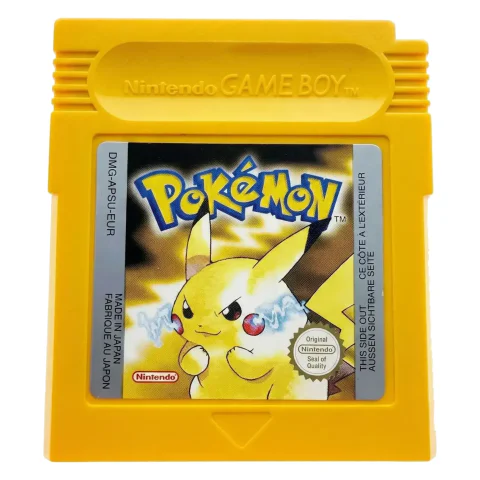
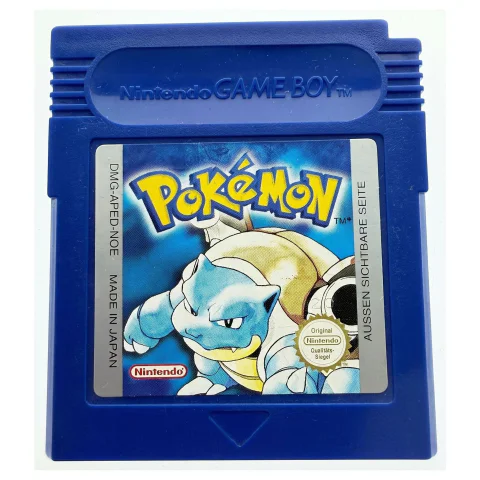
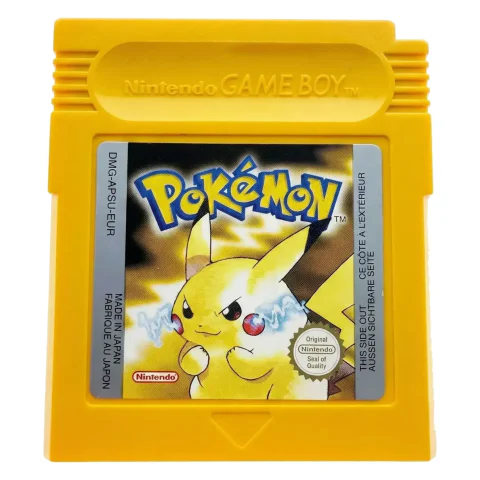
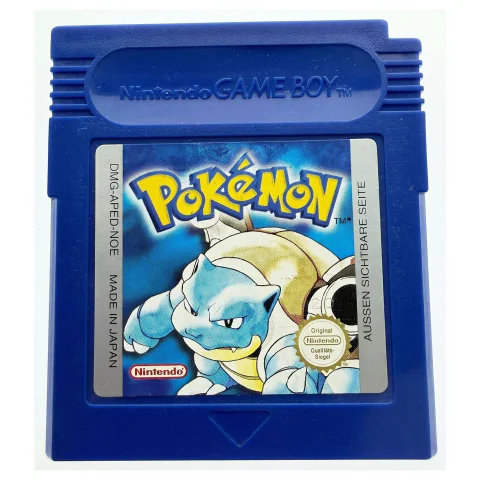
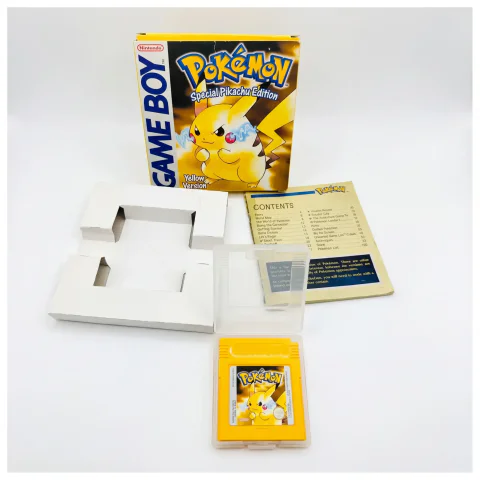
Red or Blue — and where Yellow fits
Red and Blue are the same adventure with different version-exclusive Pokémon: not every one of the 151 can be caught in one cartridge, and Mew was only ever handed out at events. Completing the Pokédex meant trading with a second player over a link cable — that was the design from day one.
Yellow — the Special Pikachu Edition — retells generation 1 the way the animated series does: you start with Pikachu, which walks behind you instead of sitting in its Poké Ball and shows its mood, Jessie and James turn up throughout the story, and Bulbasaur, Charmander and Squirtle can all be obtained. It was also one of the first cartridges with colour support on a Game Boy Color.
Why Europe never got Pokémon Green
In Japan the first pair was Red and Green (1996). For the rest of the world Nintendo merged them into Red and Blue, built on the technically improved Japanese Blue version. The "Blue" sold here is therefore a different game from the Japanese Blue — and Green was never released outside Japan, which is why it only turns up as an import.
The save battery — the one check that matters here
Generation 1 keeps your progress in SRAM powered by a CR2025 button cell inside the cartridge. After twenty-five years it is often flat. The game then still plays perfectly — but your progress is gone the moment you switch off. On GBA and DS Pokémon a flat battery is a footnote; here it is the whole difference between a game you can play and one you can only start.
The cell is replaceable — soldered to the board, so it takes a soldering iron rather than a click, and an existing save does not survive the swap. We power every copy off, wait, check that the save is still there and state the result on the listing. Treat a flat battery as a price point, not a dealbreaker.
Which Game Boy plays them
Any original Game Boy, Game Boy Pocket, Game Boy Color, Game Boy Advance or Advance SP — Yellow shows its colour on a Color or Advance. The Game Boy Micro and the Nintendo DS family cannot play them: no Game Boy slot. The Advance SP, with its lit screen, is the comfortable way to play a game from 1999; we keep tested Game Boy, Color and Advance consoles on the shelf for exactly that.
Real or fake
- The save test. Save, power off, restart. A working cell keeps the game; many counterfeit boards save badly or lose the save straight away.
- Label and weight. An original has a sharp, matte label and real heft; a fake is lighter and its print blurred or too glossy.
- The screw. One 3.8 mm gamebit Nintendo screw on the back — a Phillips screw is a warning sign.
- The board inside. A real Nintendo PCB with a battery in its holder, not a single black blob on a green board.
Pokémon is the most counterfeited game series there is, and generation 1 especially. Those checks come straight from our full fake-cartridge guide — written from the roughly 12% of cartridges we reject when buying stock.
Originals or a remake?
Kanto has been remade twice. FireRed and LeafGreen (Game Boy Advance, 2004) tell the same story with a colour screen, an updated interface and the Sevii Islands added — they sit in our Pokémon GBA list. Let's Go, Pikachu and Let's Go, Eevee (Switch, 2018) are based on Yellow and use the catching mechanics of Pokémon GO. Looking for the 1999 original on a Game Boy, this is the page; the next generation, Gold, Silver & Crystal, runs on the same handheld.
Buy one already tested
Kanto cartridges reach us one at a time, so what is on the shelf changes — but every Red, Blue or Yellow we list has been through the label, screw and board checks and a real save test on hardware, with the battery status stated. We have been doing this since 2019, with 1400+ verified reviews at 4.8★, and we ship tracked from the Netherlands to all 27 EU countries — no customs inside the EU.
Questions we get asked
What is the difference between Pokémon Red, Blue and Yellow?
Red and Blue tell the same story and differ only in version-exclusive Pokémon. Yellow is the revised version based on the animated series: you start with Pikachu, which walks behind you instead of sitting in its Poké Ball and shows its mood, Jessie and James turn up throughout the story, and you can obtain all three regular starters — in Red and Blue you have to choose. The gym leaders in Yellow are put together slightly differently, too.
Why is there no Pokémon Green in Europe?
In Japan the first pair was Red and Green (1996). For the rest of the world Nintendo merged them into Red and Blue, built on the technically improved Japanese Blue version. What is sold as "Blue" here is therefore a different game from the Japanese Blue — and Green was never released outside Japan.
Does the save still work after all these years?
That depends on the battery. Generation 1 keeps your save in SRAM powered by a button cell inside the cartridge, and after twenty-five years it is often flat — the game then plays perfectly, but your progress is gone the moment you switch off. We test saving on every copy and state the battery status on the listing. The cell is replaceable, so treat it as a price point rather than a dealbreaker.
Can the battery be replaced?
Yes. It is a CR2025 button cell soldered to the board with tabs, so replacing it takes a soldering iron rather than a click, and the existing save is lost unless it is kept alive with a separate technique. A flat cell is a wear part, not a broken cartridge.
Which Game Boy plays Red, Blue and Yellow?
Any original Game Boy, Game Boy Pocket, Game Boy Color, Game Boy Advance or Advance SP. Yellow was one of the first cartridges with colour support on a Game Boy Color, so that is where it looks best. Two things do not play them: the Game Boy Micro, which dropped Game Boy support, and the Nintendo DS family, which has no Game Boy slot.
How many Pokémon are in Red, Blue and Yellow?
The original 151, from Bulbasaur to Mew. Not all of them can be caught in one version — some appear only in Red or only in Blue — and Mew was officially only available through events. Completing the Pokédex took trading with a second player; that was the idea from the start.
Is there a modern version of Red, Blue and Yellow?
Two. FireRed and LeafGreen (2004) are the Game Boy Advance remakes, with the Sevii Islands added, and Let's Go, Pikachu and Let's Go, Eevee (2018) are the Switch version, based on Yellow and using the catching mechanics of Pokémon GO. Both tell the same Kanto story.
How do I spot a fake Red, Blue or Yellow?
Pokémon is the most counterfeited game series there is, and generation 1 especially. A fake is lighter, its label print blurred or too glossy, and it often saves badly. An original has a sharp, matte label, a single 3.8 mm gamebit Nintendo screw on the back and a real Nintendo board inside. The decisive test is saving — power off, restart, and the game must still be there. We run it on every cartridge.
Where Kanto fits in the series: all Pokémon games in order — or the full Pokémon Game Boy list.
Dutch reader? Pokémon Red, Blue & Yellow kopen — dezelfde gids in het Nederlands.